12. Interaction
interact puts controls on a figure. In a notebook the cell becomes a live figure: the reader moves
a slider, the kernel runs the view again with the new value, and the figure that comes back is
drawn by the same code as every other figure in this guide.
| The view receives | The label reads | |
|---|---|---|
Control.slider u label lo hi init |
float<'u> |
the value in 'u, under one prefix chosen for the whole range |
Control.sliderBy u label lo hi step init |
float<'u> |
as above, in steps |
Control.select label [ name, value; … ] init |
the chosen value | its name |
Control.checkbox label init |
bool |
on or off |
Control.time label lo hi |
float<s> |
a range with a play button, for a trajectory |
A control is typed: a slider over rad/s² hands the view a float<rad/s^2>, and its label is written
in that unit. The block is applicative, let! … and! … return, so the set of controls is known
before the view runs and cannot depend on a control's value.
A driven pendulum on the way to chaos
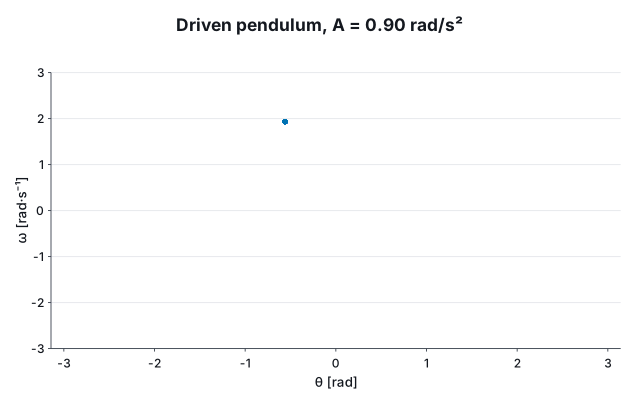
A damped pendulum driven at two thirds of its natural frequency. Its state is sampled once per drive period, a stroboscopic Poincaré section, after the transient has died. At a small drive the section is a point, a periodic orbit; as the drive grows the orbit doubles and the section fills out into a strange attractor, with windows where order returns. One slider sets the drive's amplitude:
let naturalRate = 1.0<1/s^2>
let pendulumDamping = 0.5</s>
let driveFrequency = 2.0 / 3.0 * 1.0<rad/s>
let drivePeriod = 2.0 * System.Math.PI * 1.0<rad> / driveFrequency

let drivenPendulum (amplitude: float<rad/s^2>) : Flow2T<rad, rad/s, s> =
    fun t th om ->
        struct (om, -naturalRate * sin (float th) * 1.0<rad> - pendulumDamping * om + amplitude * cos (float (driveFrequency * t)))

let strobe (amplitude: float<rad/s^2>) =
    Sim.ofStep (drivePeriod / 400.0) (Ode.rk4 (drivenPendulum amplitude)) (struct (0.2<rad>, 0.0<rad/s>))
    |> Sim.trajectory drivePeriod (240.0 * drivePeriod)
    |> Poincare.stroboscopic drivePeriod
    |> Array.skip 40

let sectionAt (amplitude: float<rad/s^2>) =
    let points = strobe amplitude

    Chart.scatterIn U.radian angularVelocity
        (points |> Array.map (fun p -> let struct (th, _) = p.State in wrapAngle th))
        (points |> Array.map (fun p -> let struct (_, om) = p.State in om))
    |> Chart.withXDomain (-System.Math.PI) System.Math.PI
    |> Chart.withYDomain -3.0 3.0
    |> Chart.withTitle (sprintf "Driven pendulum, A = %.2f rad/s²" (float amplitude))

let angularAcceleration = U.div U.radian (U.mul U.second U.second)

let explorer =
    interact {
        let! amplitude = Control.slider angularAcceleration "A" 0.9<rad/s^2> 1.5<rad/s^2> 0.9<rad/s^2>
        return sectionAt amplitude
    }

explorer
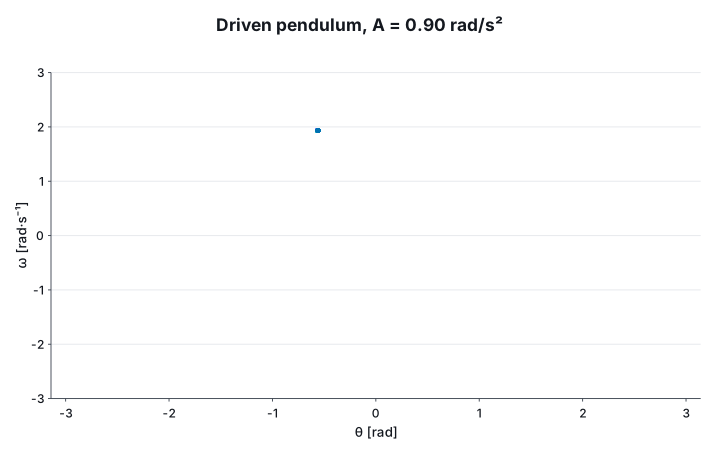
In Verso, explorer as a cell's value is the live figure: drag the slider and the section is
recomputed for that drive. On the figure, a drag zooms onto a box, shift-drag pans, a double-click
returns to the view's own domains, and the pointer's position is read out in the axes' units. The
page formats no number; every label and reading is written by the kernel.
A live figure is a value
What the notebook does is a fold over the reader's messages, and it runs without a notebook. A
message is Set (control, value), a zoom, a pan, a hover or a resize, and Live.step is total: a
message it cannot use returns the state it was given, because a page in someone's browser sent it.
let atStart = Live.init explorer
let pushed = Live.step explorer atStart (Set(0, 1.2))

printfn "%s" (String.concat ", " (Live.shown explorer pushed))
printfn "the same message gives the same state: %b" (Live.step explorer atStart (Set(0, 1.2)) = pushed)
printfn "a message for no control changes nothing: %b" (obj.ReferenceEquals(Live.step explorer atStart (Set(7, 1.0)), atStart))
The figure is laid out once, against the states its controls reach at their extremes, so the plot area holds still while the reader drags.
Recorded
Because the step is pure, a session is its messages. Live.recorder keeps what a reader did, with
the page's own times, LiveLog writes it as JSON and reads it back exactly, and Live.film replays
it as a film. Here, a session that walks the drive from 0.9 to 1.5 rad/s²:
let session = Recording.ofEvents [| for i in 0..12 -> 0.5<s> * float i, Set(0, 0.9 + 0.05 * float i) |]

printfn "the log reads back exactly: %b" (LiveLog.ofJson (LiveLog.toJson session) = Ok session)

Live.film explorer (Live.record explorer session)