9. Animation
An animation is a pure function of time, Anim<'a>: a duration and the value at each instant.
Nothing is stepped, so frame 900 costs what frame 1 costs, frames can be asked for in any order,
and a timeline can be scrubbed.
let climb = Anim.tween 2.0<s> 0.0<m> 100.0<m>

printfn "at 1 s: %.1f m; at 90%%: %.1f m; past the end: %.1f m"
    (float (climb |> Anim.at 1.0<s>)) (float (climb |> Anim.atFraction 0.9)) (float (climb |> Anim.at 9.0<s>))
Anim.tween interpolates anything Core can: a float<'u>, a Vec2, a Rect, an affine
transform, a Color through Oklab, so a fade from blue to yellow does not pass through grey.
Composing
Anim.map2 runs two animations side by side, for the longer of their durations, the shorter
holding its last value; Anim.andThen runs one after the other, for the sum. Anim.map turns the
values into something else, Anim.stretch scales the duration, and Anim.ease reparameterises
the clock with one of the twenty-eight easings in Ease: quad, cubic, quart, sine, expo, circ,
back, elastic and bounce, each in, out and in-out, and linear.
let upAndDown = Anim.andThen climb (Anim.tween 1.0<s> 100.0<m> 0.0<m>)
let overshoot = Anim.tween 1.0<s> 0.0 1.0 |> Anim.ease Ease.backOut

printfn "up then down lasts %.1f s" (float (Anim.duration upAndDown))
printfn "backOut overshoots to %.3f and lands on %.3f" (overshoot |> Anim.atFraction 0.35) (overshoot |> Anim.atFraction 1.0)
Anim.at clamps its time to the duration, which is what makes the hold and andThen well
defined; the eased fraction is not clamped, which is what lets backOut overshoot. Morph.anim
turns one path into another, resampled by arc length so the change runs at an even speed.
Animating a figure
An animation of figures becomes a film with Film.ofFigures samples extent. Laid out frame by
frame, a panel would breathe: a y axis climbing past 100 gains a digit on every label, the gutter
widens, and the plot moves while the data was meant to. So a film is laid out once, over the union
of its sampled states, and every frame is drawn inside that layout. The same union holds each
axis's prefix, so a zoom across a decade does not step mm to µm mid-shot, and each colour
scale, so a field that grows is seen to grow.
The Bode plot, sweeping its damping
§4's filter, with its damping ratio eased from 0.05 to 1 over three seconds. The resonant peak falls and broadens, the phase's step softens, and the panel, the ticks' room and both titles stay where they are:
let bodeFor (damping: float) =
    let gainAt (f: float<Hz>) =
        let r = f / cutoff
        1.0 / sqrt ((1.0 - r * r) ** 2.0 + (2.0 * damping * r) ** 2.0)

    let phaseAt (f: float<Hz>) =
        let r = f / cutoff
        -(atan2 (2.0 * damping * r) (1.0 - r * r)) * 1.0<rad>

    Chart.lineIn U.hertz U.one bodeFrequencies (bodeFrequencies |> Array.map gainAt)
    |> Chart.withName "gain"
    |> Chart.addVLine U.hertz cutoff
    |> Chart.withXLog
    |> Chart.withYLog
    |> Chart.withYDomain 1e-4 20.0
    |> Chart.withRightAxis (
        Chart.lineIn U.hertz U.radian bodeFrequencies (bodeFrequencies |> Array.map phaseAt)
        |> Chart.withName "phase"
        |> Chart.withXLog
        |> Chart.withYTicksNamed U.radian [| 0.0<rad>, "0"; -halfTurn / 2.0, "−π/2"; -halfTurn, "−π" |]
    )
    |> Chart.withXLabel "f"
    |> Chart.withYLabel "|H|"
    |> Chart.withRightYLabel "φ"
    |> Chart.withLegend LegendBottomLeft
    |> Chart.withTitle (sprintf "A second-order low-pass filter, ζ = %.2f" damping)

Anim.tween 3.0<s> 0.05 1.0
|> Anim.ease Ease.sineInOut
|> Anim.map bodeFor
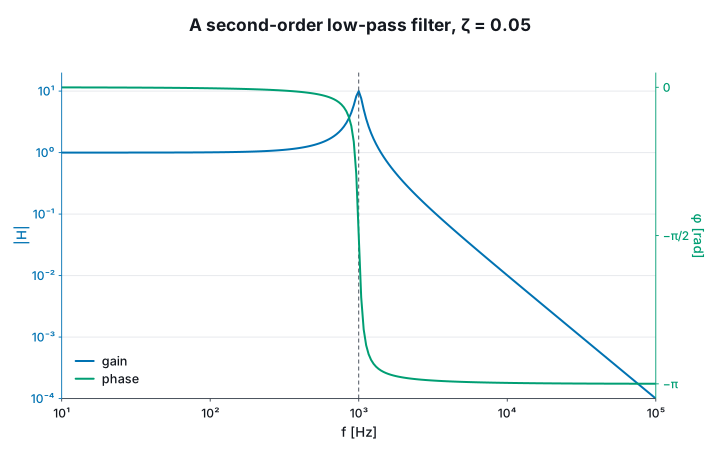
The y domain is stated, because the peak at ζ = 0.05 is ten times the gain at ζ = 1 and a domain that followed each frame would rescale the axis under the curve. The title is the one thing that changes with the data.