10. The storyboard
An animation is usually a sequence: something arrives, it changes, an axis zooms, one point is
picked out. The scene block does the arithmetic of which step is running and how far through it.
open Marey.Storyboard

let resonanceStory =
    scene {
        let! points = draw (Chart.scatterIn U.hertz U.metre drive amplitude) |> over 1.0<s>
        do! wait 0.4<s>

        do!
            parallel'
                [ points |> morphTo (Chart.scatterIn U.hertz U.metre drive (drive |> Array.map (response 25.0))) |> over 1.2<s>
                  points |> zoomToX (960.0, 1040.0) |> over 1.2<s> ]

        do! highlight points.[10] |> over 0.6<s>
        do! wait 0.6<s>
    }

printfn "the story runs for %.1f s" (float (Storyboard.duration resonanceStory))
The block is a value: nothing is measured or drawn until it is filmed.
What let! binds is a handle: a name for something on stage, and the time it took to arrive,
which is the default duration for every verb applied to it later. points is used three times
after it is bound, each time to mean the scatter already drawn.
The verbs. draw fig puts a figure on stage and reveals it; over d says how long a step
takes, and wait d holds. parallel' runs branches together, for the longest of them. morphTo
interpolates the data into another figure's, so every instant is a real figure whose ticks and
prefix come from the numbers on screen, and two series in kilometres and metres morph by
converting. zoomToX and zoomToY animate a domain, highlight h.[i] grows one mark and rings it,
and fadeIn fades a named part in.
points.[10] names the eleventh datum. A scatter of 100 000 points is one node, so naming one
splits it into the marks before, the mark, and the marks after; nothing is split until something is
named. When rows have names of their own, key in the plot block keys each mark by its row's
name, so a morph between two tables pairs rows by name: the rows that stayed hold still, a removed
row fades out where it was, and points.["S6"] names a row by its key.
Filmed
Film.ofStory samples extent story samples the story, lays it out once over everything it saw,
and holds every frame inside that layout, as §9's films are:
Film.ofStory 32 (Chart.size 720.0 450.0) resonanceStory

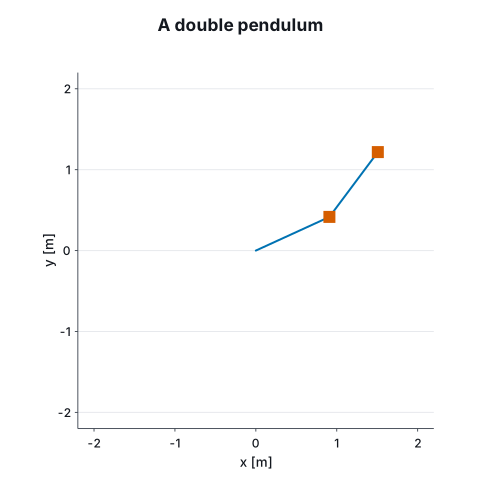
An animation of figures is a film too, with no storyboard: the double pendulum of §8, drawn at each instant of its trajectory.
let drawArms (a: Arms) =
    let x1, y1 = armLength * sin (float a.T1), -armLength * cos (float a.T1)
    let x2, y2 = x1 + armLength * sin (float a.T2), y1 - armLength * cos (float a.T2)

    Chart.lineIn U.metre U.metre [| 0.0<m>; x1; x2 |] [| 0.0<m>; y1; y2 |]
    |> Chart.addScatterIn U.metre U.metre [| x1; x2 |] [| y1; y2 |]
    |> Chart.withStyle (Geom.withMarkerSize 12.0<px>)
    |> Chart.withXDomain -2.2 2.2
    |> Chart.withYDomain -2.2 2.2
    |> Chart.withXLabel "x"
    |> Chart.withYLabel "y"
    |> Chart.withEqualAspect
    |> Chart.withTitle "A double pendulum"

let swingFilm = Film.ofFigures 40 (Chart.size 480.0 480.0) (Anim.map drawArms (Sim.trajectory 0.25<s> 4.0<s> doublePendulum))
swingFilm
Frames and video
Frames.write renders a film's frames, on every core, to numbered files at a frame rate, and
reports any file of the same pattern it did not write: a frame left from a longer render would
otherwise be read on into the video. Marey.Tools.Video encodes the frames with ffmpeg, found on
PATH; a missing ffmpeg is an outcome that says what to install, and the frames stay on disk.
Video.args is the command as a value, and Video.inspect reads the result back with ffprobe.
#r "nuget: Marey.Tools.Video"

let swingFrames =
    swingFilm |> Frames.write FramePass.Concurrent SkiaBackend.renderPng (FrameTarget.into "swing" ".png") 20.0

match Video.mux MuxOptions.Default swingFrames "swing.mp4" with
| MuxRan run when run.Succeeded ->
    match Video.inspect run.Output with
    | Inspected info -> printfn "swing.mp4: %s, %d × %d, %d frames at %g fps" info.Codec info.Width info.Height info.FrameCount info.Fps
    | other -> printfn "%A" other
| MuxUnavailable why -> printfn "%s" why
| other -> printfn "%A" other
Typeset text
Marey.Tools.Tex sets TeX with latex, turns it into outlines with dvisvgm, and puts the
outlines in the scene in place of the text, so every backend draws the formula with the code it
already has. Any text run can carry a TeX form beside its plain one, and the axis titles under
Theme.tikz carry theirs. Without TeX on the machine, the plain text is drawn and the call says
so; a formula TeX rejects keeps its text, alone. TexCache keeps the outlines across the frames
of a film.
#r "nuget: Marey.Tools.Tex"

let equationOfMotion: Node =
    Text
        { Text = "θ'' = −(g/l) sin θ"
          Tex = Some @"$\ddot\theta = -\frac{g}{l}\sin\theta$"
          At = { X = 0.5<nd>; Y = 0.5<nd> }
          Font = { Family = Theme.Serif; Size = 20.0<pt>; Weight = 400; Italic = false }
          Paint = Solid(Color.rgb 0.1 0.1 0.12)
          Anchor = AnchorMiddle
          Baseline = BaselineAlphabetic
          Rotation = 0.0<rad> }

let typeset, typesetNote = Typeset.sceneOrPlain TexOptions.Default (Chart.size 360.0 100.0) equationOfMotion

printfn "%s" typesetNote